Written
BEV, PHEV, HEV, ICE – Confusing EV terms explained
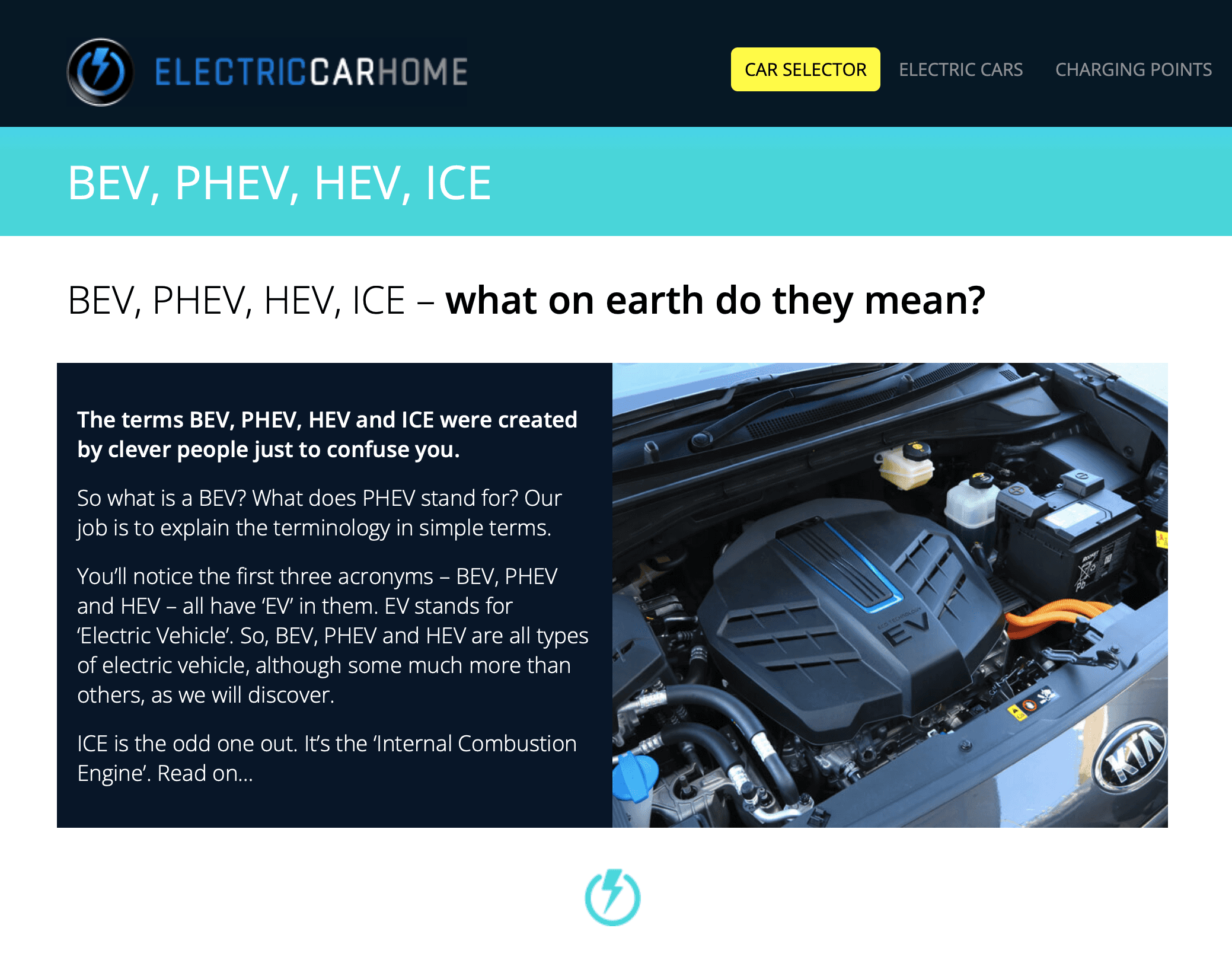
BEV, PHEV, HEV, ICE – Confusing electric car terms explained
This page addresses one of the single biggest barriers to entry for new EV buyers: the ‘alphabet soup’ of industry acronyms.
For someone transitioning from a petrol or diesel car, terms like BEV and PHEV aren't just confusing, they are distinctly alienating.
My strategy for this piece was to strip away the technical veneer and use humour to lower the reader's anxiety.
The Strategy: Radical Simplicity. Instead of dry, dictionary-style definitions, I adopted a conversational, ‘explain-it-like-I'm-a-5-year-old’ tone. The goal was to align with the reader's frustration immediately by acknowledging that these terms were ‘created by clever people just to confuse you’.
Key Copywriting Techniques:
Deconstruction: I broke the acronyms down letter-by-letter (e.g. B = Battery) to reveal the simple logic hidden behind the jargon.
Memorable analogies: To make the naming conventions stick, I used extreme examples, such as the ‘MEV’ (Milk Electric Vehicle) to highlight how the descriptive naming system works.
Differentiation: A core objective was to clearly distinguish between ‘Plug-in’ hybrids and HEVs or ‘Self-charging’ hybrids, a common pain point for consumers. I achieved this by focusing on the action required by the user (plugging in vs. filling up) rather than just the drivetrain mechanics.
This guide serves as a high-traffic entry point (top-of-funnel) that establishes Electric Car Home as a down-to-earth, accessible authority in a sector often criticised for being too technical.